Microsoft 365
Introduction
This guide explains how to authenticate the Microsoft Graph API connector in Swimlane using one of the following authentication methods:
- OAuth 2.0 Client Credentials (Application permissions)
- OAuth 2.0 Refresh Token Grant (Delegated permissions with MFA)
You will create an Azure app, assign permissions, collect the required identifiers, and configure the connector inside Swimlane.
Prerequisites
Azure Access Requirements
You must have Azure permissions to:
- Register applications in Azure Active Directory
- Assign API permissions
- Grant admin consent
- Create and manage client secrets
- Assign directory roles (Global Reader, Security Reader)
- View tenant, subscription, and organizational properties
Required Credentials
During setup, you will collect:
- Client ID
- Client Secret
- Tenant ID
- Token URL (for Client Credentials flow)
- Refresh Token (for Refresh Token flow)
- Scopes (API permissions required for Office 365)
- Host URL (Office 365 service endpoint)
Authentication Methods Overview
OAuth 2.0 Client Credentials
Used for non-MFA accounts and for most server-to-server automations.
You will need:
- Client ID
- Client Secret
- Tenant ID
- Token URL (must include Tenant ID)
- Scope(s)
OAuth 2.0 Refresh Token Grant
Use this when:
- The Office 365 account has MFA enabled
- You need a long-lived token flow based on user authentication
You will need:
- Client ID
- Client Secret
- Refresh Token
- Redirect URI (added during Azure App Registration)
Azure Setup
Take the following steps to register the application:
- Go to Azure Portal > Azure Active Directory > App Registrations
- Click New Registration.
- Enter an application name.
- Select Accounts in this organizational directory only.
- (Refresh Token method only) Add a Redirect URI (Platform: Web).
- Click Register.
Take the following steps to assign the API permissions:
- Open the API Permissions tab.
- Click Add a permission.
- Select APIs my organization uses.
- Search and select Office 365 Exchange Online.
- Add the required permissions (recommended):
- ReportingWebService.Read
- (Any additional permissions needed for your actions)
- Click Add permissions.
- Click Grant admin consent for your organization.
Take the following steps to generate a client secret
- Go to Certificates & secrets.
- Click New client secret.
- Add description and expiration.
- Click Add.
- Copy and save the value. This saved value is Client Secret.
Take the following steps to collect required Identifiers:
From App Registration > Overview, copy:
- Client ID
- Tenant ID
From the Office Azure tenant workspace, copy:
- Organization/Tenant ID
- Subscription ID (if applicable to your environment)
- Any required Office 365 identifiers used in your actions
Additional Step (Required for Trace Reports)
Assign Required Directory Roles
Office 365 Message Trace APIs require:
- Global Reader
- Security Reader
Steps:
- Go to Azure Active Directory.
- Open Roles and administrators.
- Search Global Reader.
- Click the role name (not the checkbox).
- Click Add assignments.
- Search for your app > Select > Add.
- Set Assignment type = Active.
- Repeat for Security Reader.
Method 1: Authenticate Using OAuth 2.0 Client Credentials
Token URL Format
https://login.microsoftonline.com/{tenant_id}/oauth2/v2.0/token
Host URL
(Your Office 365 endpoint - usually service-specific)
Method 2: Authenticate Using OAuth 2.0 Refresh Token Grant
Use this for MFA-enabled accounts
Additional Requirements
- Redirect URI must be provided during registration.
- A Refresh Token must be generated using the Swimlane-provided script.
How the Refresh Token Is Generated?
Swimlane will provide:
- A Python script
- Instructions to log in using your Azure user
- The script returns:
- refresh_token
- access_token (not used in Turbine)
Refresh Tokens expire every 90 days (or sooner if your organization enforces a shorter policy). You must update the asset before expiry.
Connector Configuration in Swimlane
- Log into Turbine.
- From the left-hand navigation pane, click ORCHESTRATION and click Assets. Asset homepage opens.
- Click the + icon to create a new asset.
- Select Microsoft Office 365 from the Asset Type list.
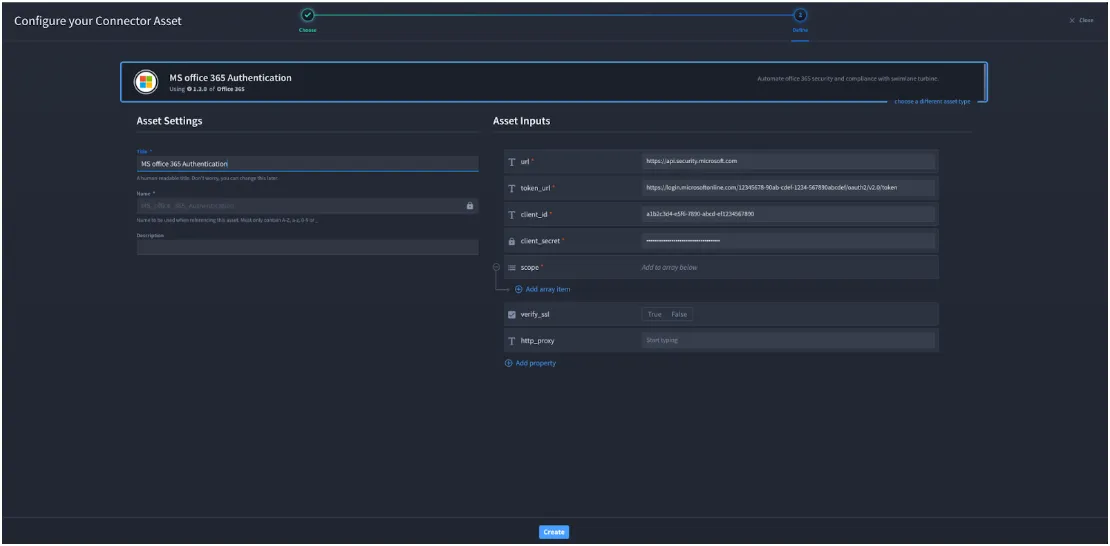
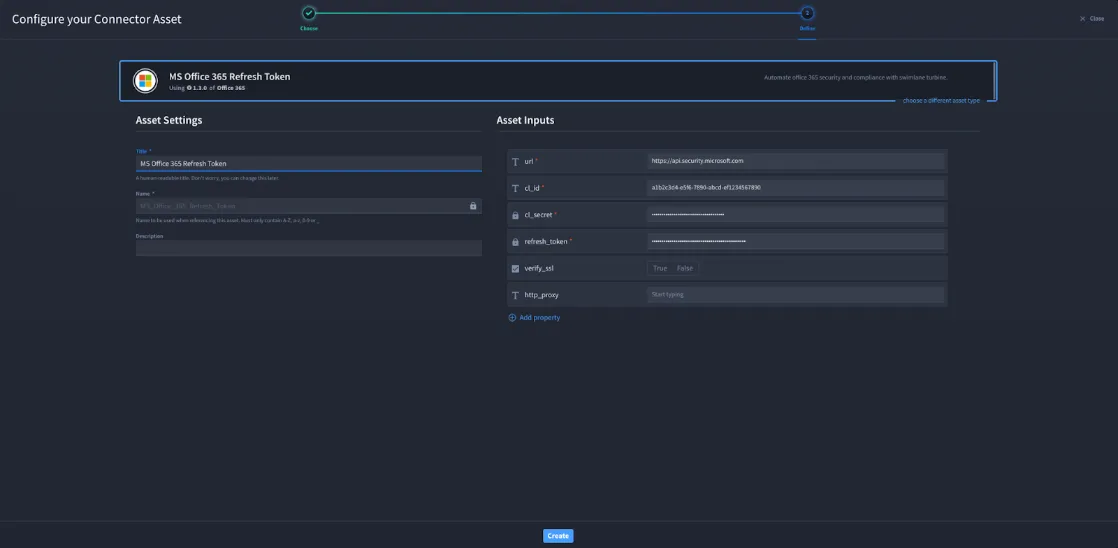
- Fill in the Asset Settings and Asset Input as shown: a) Configuration - OAuth 2.0 Client Credentials
Field | Description | Required/Optional |
|---|---|---|
url | Office 365 Host URL | Required |
token_url | Token URL including tenant_id | Required |
client_id | Client ID from Azure | Required |
client_secret | Client secret from Azure | Required |
scope | API scope added in the permission step | Required |
verify_ssl | SSL verification | Optional |
http_proxy | Proxy to route requests | Optional |
Fields with * marks are required.
b) Configuration - OAuth 2.0 Refresh Token Grant
Field | Description | Required/Optional |
|---|---|---|
url | Office 365 Host URL | Required |
cl_id | Client ID | Required |
cl_secret | Client Secret | Required |
refresh_token | Refresh token generated via script | Required |
verify_ssl | SSL verification | Optional |
http_proxy | Proxy to route requests | Optional |
Fields with * marks are required.
6. Click Create.
Troubleshooting
If you encounter a 403 Forbidden error:
- Ensure Global Reader and Security Reader roles are correctly assigned.
- Confirm admin consent is granted.
- Verify API permissions match connector actions.
If you encounter 401 Unauthorized error:
- Incorrect Client Secret, create a new one.
- Missing scopes, re-add required permissions.
- Token expired, regenerate Refresh Token.
You have successfully authenticated the Microsoft Office 365 connector in Swimlane using either Client Credentials or Refresh Token authentication.