Configure Custom Case and Incident Management Data Mappings
Because TEDS (Turbine Extendable Data Schema) relies on the most common attributes for a given object type, such as alerts, there are vendor-specific fields that are not mapped in TEDS objects. In order to map these fields to Case and Incident Management (CIM) records, you will need to use the SOC - Extract Raw Alert Fields to CIM playbook to extract values from the raw alert object included in the TEDS object and record, and write those values to fields you have created in the CIM application.
There are two approaches to mapping custom fields:
Prerequisites
Before configuring custom field mappings:
- Have access to the SOC - Extract Raw Alert Fields to CIM playbook
- Understand the structure of your raw alert data
- Have created custom fields in the CIM application for the fields you want to map
- Know the exact field key names in your CIM application (they must match exactly)
Option 1 - Discrete Mappings (Native Transformations)
This approach uses individual transformation blocks for each field you want to extract. Use this method when you have a small number of fields or need different transformation logic for each field.
Step 1: Create Custom Fields in CIM Application
- Navigate to Applications in the Swimlane platform.
- Open the Case and Incident Management (CIM) application.
- For each vendor-specific field you want to add:
- Create a new field of the appropriate type (text, number, date, etc.)
- Important: Note the exact field key name - it must match exactly what you'll use in the mapping
- Configure any field properties (required, default values, etc.)
Step 2: Edit the Extract Raw Alert Fields to CIM Playbook
- Navigate to Orchestration → Playbooks.
- Locate and open the SOC - Extract Raw Alert Fields to CIM playbook.
- Review the playbook structure to understand the workflow.
Step 3: Configure Field Extraction
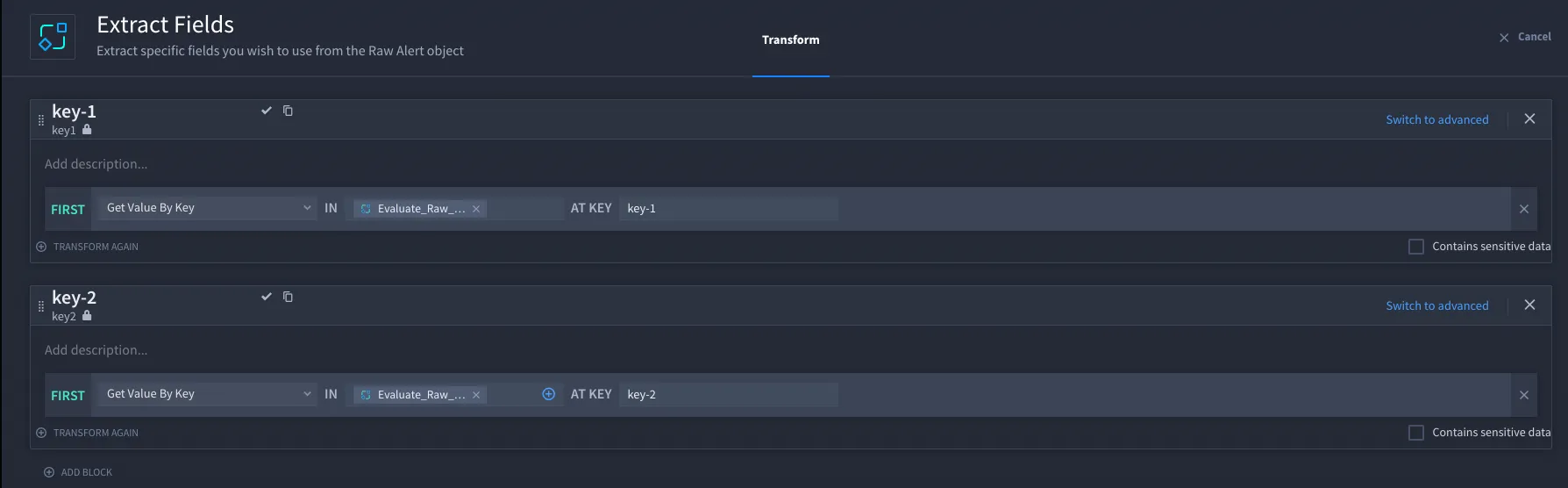
For each vendor-specific field you wish to extract to CIM:
3.1: Create a Transformation Block
- Locate the Extract Fields action in the playbook.
- Click Edit on the Extract Fields action.
- Create a new Transformation Block:
- Click "Add Transformation" or "New Block"
- Select the transformation type (typically "Get Value By Key" or similar)
3.2: Configure the Get Value By Key Transformation
- In the transformation block, select Get Value By Key transformation.
- Configure the transformation:
- Property: Navigate to and select: Evaluate Raw Alert → Raw Alert → This is the playbook data property that contains the raw alert object
- Key: Enter the exact key name from your raw alert JSON that contains the value you want to extract
- Example: If your raw alert has {"vendor_id": "12345"}, the key would be vendor_id
- Default Value (optional): Set a default value if the key doesn't exist
Navigation Path:
- In the property selector, expand: Playbook Properties → Evaluate Raw Alert → result → raw_alert
- Or search for: Evaluate_Raw_Alert.result.raw_alert
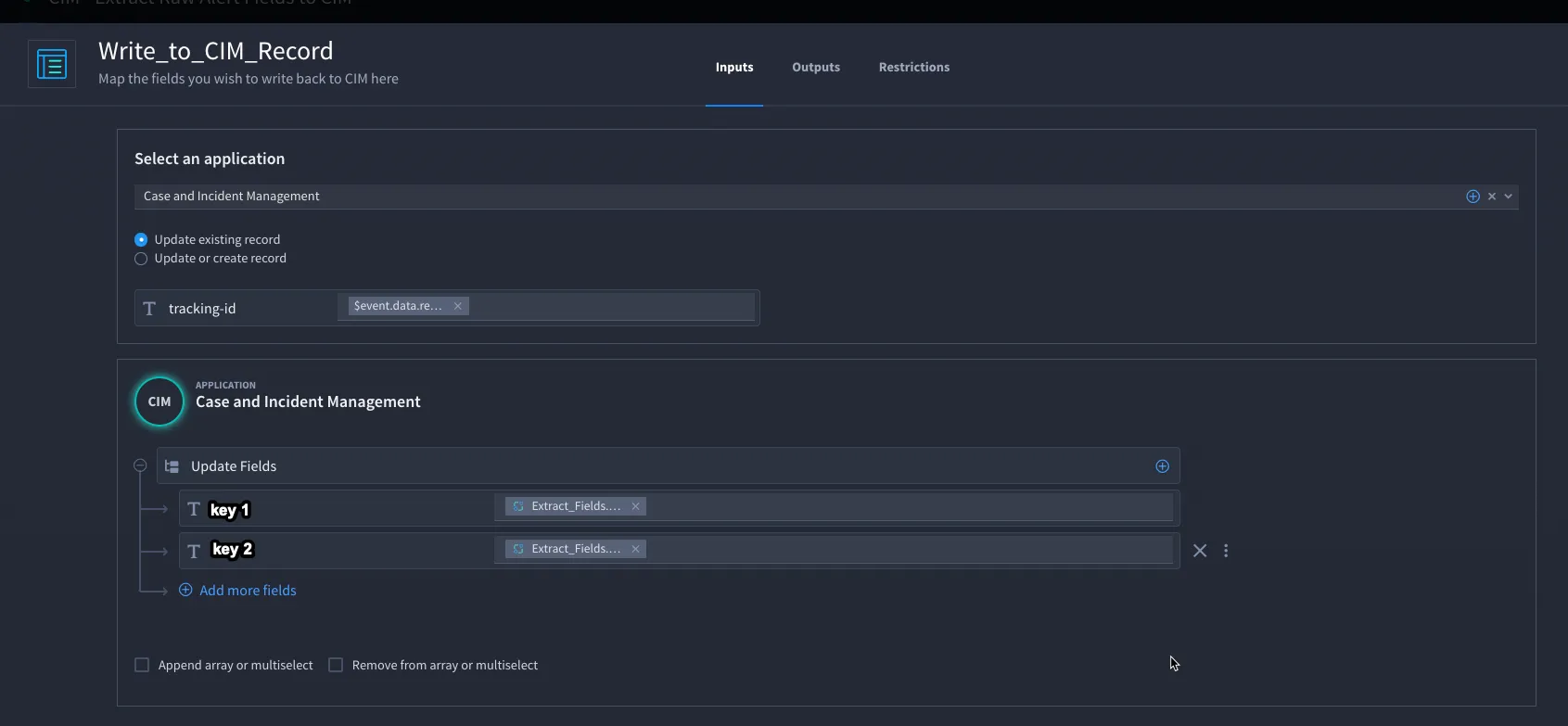
3.3: Map to CIM Record Field
- Locate the Write to CIM Record action in the playbook (typically after the Extract Fields action).
- Click Edit on the Write to CIM Record action.
- Navigate to Update Fields section.
- Add your created CIM field to the Update Fields mapping:
- Select the field you created in Step 1
- Map the transformation value from Step 3.2 to this field
- Ensure the field key name in CIM exactly matches what you're mapping
Example Configuration:
If extracting a vendor_severity field:
- Transformation: Get Value By Key from Evaluate_Raw_Alert.result.raw_alert with key vendor_severity
- CIM Field: Map to a field named exactly vendor_severity in your CIM application
Step 4: Repeat for Each Field
Repeat Steps 3.1-3.3 for each vendor-specific field you want to extract.
Option 2 - Bulk Mappings (Advanced Transformations)
This approach uses a single advanced transformation block to extract multiple fields at once. Use this method when you have many fields or want to map all fields from the raw alert object.
Step 1: Create Fields in CIM Application
- Navigate to Applications → Case and Incident Management (CIM) application.
- Create fields of the appropriate types for all the vendor-specific fields you want to map.
- Critical: Ensure the field key names in CIM exactly match the key names in your raw alert JSON.
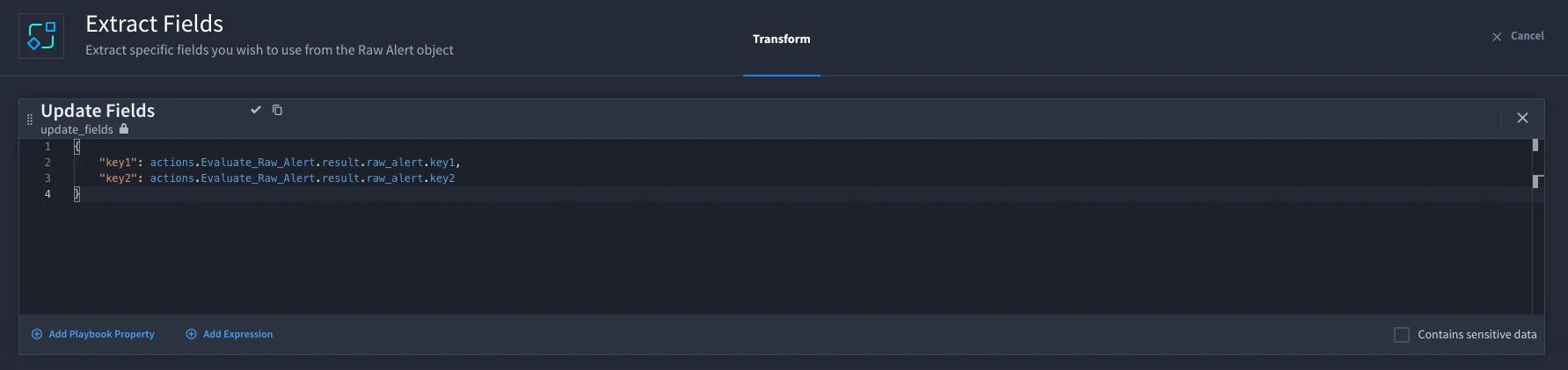
Step 2: Create Advanced Transformation Block
- Navigate to Orchestration → Playbooks.
- Open the SOC - Extract Raw Alert Fields to CIM playbook.
- Locate the Extract Fields action.
- Click Edit on the Extract Fields action.
- Create an Advanced Transformation Block:
- Click "Add Transformation" → "Advanced" or "JSONata"
- This allows you to write custom transformation expressions
Step 3: Create JSON Mapping Object
In the advanced transformation block, create a JSON object that maps each raw alert key to the corresponding CIM field. The format is:
{
  "field-key-name-1": actions.Evaluate_Raw_Alert.result.raw_alert.'key-name-1',
  "field-key-name-2": actions.Evaluate_Raw_Alert.result.raw_alert.'key-name-2',
  "field-key-name-3": actions.Evaluate_Raw_Alert.result.raw_alert.'key-name-3'
}
Key Points:
- The left side (field key) must exactly match the CIM application field key name
- The right side references the raw alert data using: actions.Evaluate_Raw_Alert.result.raw_alert.'key-name'
- Use single quotes around key names that contain special characters or spaces
- For nested keys, use dot notation: actions.Evaluate_Raw_Alert.result.raw_alert.'nested'.'key'
Example Advanced Transformation:
{
  "vendor_alert_id": actions.Evaluate_Raw_Alert.result.raw_alert.'alert-id',
  "vendor_severity": actions.Evaluate_Raw_Alert.result.raw_alert.severity,
  "vendor_category": actions.Evaluate_Raw_Alert.result.raw_alert.category,
  "custom_metadata": actions.Evaluate_Raw_Alert.result.raw_alert.metadata
}
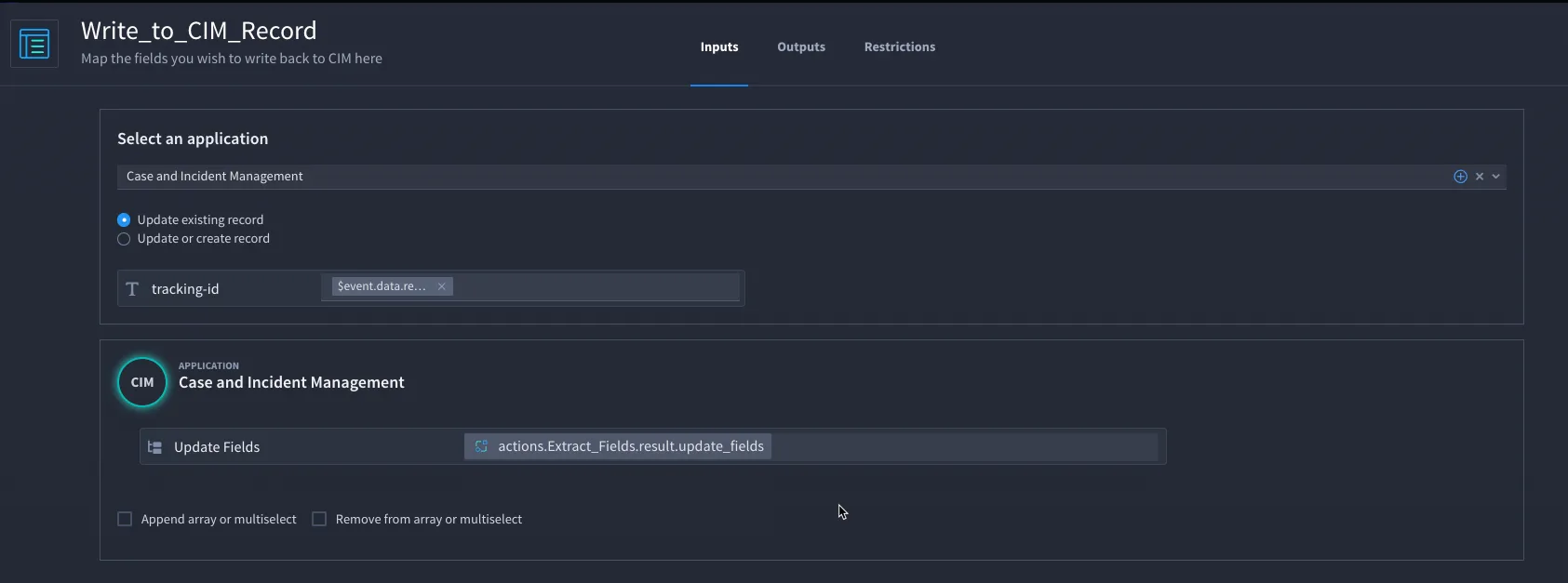
Step 4: Map to CIM Record
- Locate the Write to CIM Record action.
- Click Edit on the Write to CIM Record action.
- Navigate to Update Fields.
- Map the transformation result object as a playbook property:
- Select "Playbook Property"
- Navigate to the output of your advanced transformation block
- Map it to Update Fields
Note: When using bulk mapping, the entire transformation object is mapped to Update Fields, and Turbine automatically matches field keys to CIM application fields.
Handling Different Data Types
Text Fields
- Extract directly: actions.Evaluate_Raw_Alert.result.raw_alert.'field-name'
- Convert to string if needed: $string(actions.Evaluate_Raw_Alert.result.raw_alert.'field-name')
Number Fields
- Extract and ensure numeric type: $number(actions.Evaluate_Raw_Alert.result.raw_alert.'field-name')
Date Fields
- Extract and format if needed: actions.Evaluate_Raw_Alert.result.raw_alert.'date-field'
- Convert format if necessary using date transformation functions
Array/List Fields
- Extract array directly: actions.Evaluate_Raw_Alert.result.raw_alert.'array-field'
- Ensure the CIM field type supports arrays/lists
Nested Objects
- Access nested properties: actions.Evaluate_Raw_Alert.result.raw_alert.'parent'.'child'
- Extract specific nested values as needed
Common Issues and Solutions
Issue: Field Not Appearing in CIM Record
Possible Causes:
- Field key name doesn't match exactly between transformation and CIM application
- Field doesn't exist in CIM application
- Transformation is not extracting the value correctly
Solutions:
- Verify field key names match exactly (case-sensitive)
- Check that the field exists in the CIM application
- Test the transformation to ensure it's extracting the correct value
- Check playbook execution logs for errors
Issue: Transformation Returns Null or Undefined
Possible Causes:
- Key doesn't exist in raw alert JSON
- Key name is misspelled
- Nested path is incorrect
Solutions:
- Verify the key exists in your raw alert data
- Check for typos in key names
- Use the raw alert object structure to verify the correct path
- Add default values for missing keys: actions.Evaluate_Raw_Alert.result.raw_alert.'key' ?? 'default'
Issue: Data Type Mismatch
Possible Causes:
- CIM field expects a different data type than what's being extracted
- Transformation is returning wrong type
Solutions:
- Verify CIM field type matches the data being extracted
- Use type conversion functions in transformation (e.g., $string(), $number())
- Check transformation output data types
Best Practices
- Field Naming: Use consistent, descriptive field names that match your vendor's terminology
- Error Handling: Add default values for optional fields to prevent null errors
- Testing: Test mappings with sample data before deploying to production
- Documentation: Document which vendor fields map to which CIM fields
- Validation: Verify field mappings after any vendor API changes
- Performance: Use bulk mappings (Option 2) for many fields to improve performance
Verification
After configuration:
- Test the Playbook:
- Run the playbook with a sample alert containing vendor-specific fields
- Verify that fields are extracted correctly
- Check that values appear in CIM records
- Validate Field Values:
- Compare raw alert values with CIM record values
- Ensure data types are correct
- Verify special characters and formatting are preserved
- Check for Errors:
- Review playbook execution logs
- Check for any transformation errors
- Verify CIM record updates are successful
Related Documentation
- SOC Solutions BundleSOC Solutions Bundle Overview
- Turbine Solutions InterfacesTurbine Solutions Interfaces