Export Swimlane Solution Packages
Export Swimlane Solution Packages (SSPs, file extension .ssp) to transfer playbooks, applications, applets, builder components, builder solutions, and their dependencies to another Turbine instance or to the Content Library.
Exporting SSPs requires the System Administrator role.
What Is Included in an Export
Included | Excluded |
|---|---|
Root application, applet, playbook, builder component, or builder solution | Application history and record history |
Associated applications and applets | Records (except when exporting supported application records; see Export Application Records) |
Workflows for root and associated entities | Secure credentials and key store values (add after import) |
Reports, workspaces, dashboards, and export templates | Secure values in asset configurations (reconfigure after import) |
Playbooks, including parent and nested playbooks | Connectors (maintain separately) |
Orchestration tasks, ingestion rules, sensors, and correlation rules | |
Assets, plugins, and Dynamic Orchestration assets | |
Builder components, builder solutions, and builder intents | |
Mapped inputs to key store values (keys removed; add back after import) | |
Export an Application or Applet SSP
You can start an export from the Applications and Applets main page or from within the builder.
Export from the Applications and Applets Page
- Open the Applications and Applets page.
- Click the plus icon and select Import or Export a package.
- Select the Export radio button.
- Turbine loads the available entities. Select the check box next to each entity you want to include.
- Click Export.
- Turbine validates the selected entities and displays a preview of the package contents.
- If no errors are detected, click Export to download the .ssp file. If there are potential issues, click Continue Export to proceed or resolve the issues first. See Review Export Results.
Export from Within Application or Applet Builder
- Open the application or applet in the builder.
- Click the ellipsis icon in the taskbar menu.
- Select Export Application or Export Applet.
- Turbine displays a preview of the entity and all associated content that will be packaged.
- Review any potential issues. If no issues exist, click Export. If issues are found, click Continue Export to proceed anyway, or click Go to Application to fix errors first.
When you select one application or applet, the export packages all associated content (workflows, reports, assets, playbooks, and so on) as a single solution. Review the entity tree to confirm what is included.
Export Application Records
You can optionally export application records when exporting SSPs for supported applications.
Currently, record export is supported for:
- KB Article
- Routing Rule
When enabled, Turbine exports matching records as .csv files inside the SSP package.
Take the following Steps to Export Application Records:
- Navigate to Applications & Applets.
- Locate the application you want to export.
- Click the ellipsis menu (three dots).
- Select Export. The Package Export dialog opens.
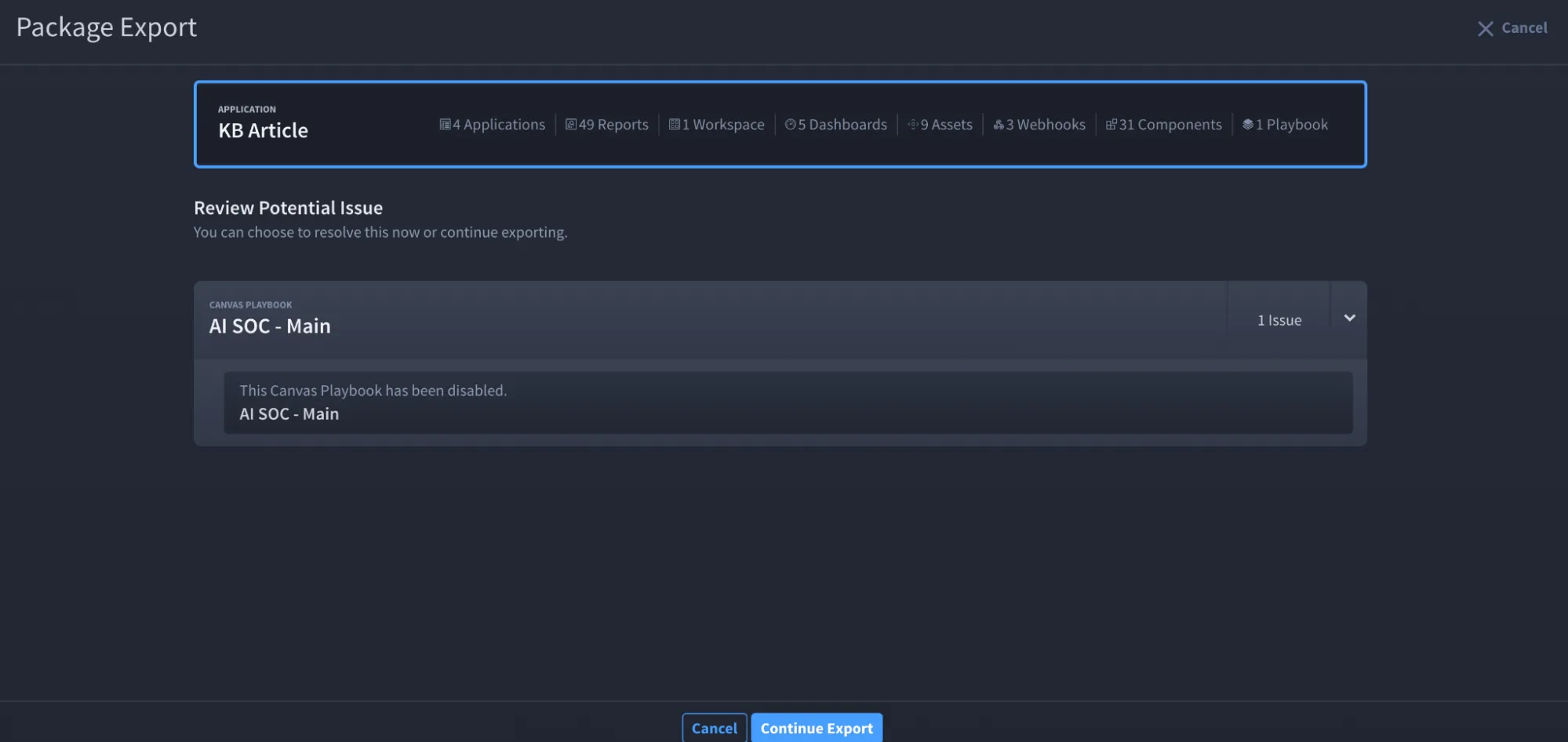
- Review any validation warnings. Click Continue Export. Turbine displays the list of entities included in the package.
- Applications that support record export display an Export Records toggle.
Record export is currently supported only for KB Article and Routing Rule applications. Rest of the applications do not have the toggle.

- Enable the Export Records toggle.
- The number of matching records appears below the toggle.
- Click Edit to configure record filtering conditions. Refer to the Filter Records Using the Condition Builder for more information.
- Click Export. Turbine generates and downloads the SSP package.
- During export:
- Turbine creates a Records folder on your local machine.
- Exported records are saved as .csv files under the Records folder.
Example: records_<applicationId>.csv

You have successfully exported the Application Records.
- Each exported record contains a sharing_uuid. The sharing_uuid:
- remains consistent across tenants
- is used to preserve record identity during import across different tenants
- If a record references another application record:
- the referenced record sharing UUID is also exported
- This allows references to be re-linked during import when matching records exist.
- The following values are not included in the exported CSV files:
- User fields
- Group fields
- Attachments fields
- Comment fields
- Record History
- Correlation fields
- The maximum export size per application is 20 MB. If the exported records exceed this limit, the most recently created records that fit within the 20 MB limit are included in the package.
- If the limit is exceeded, the remaining records are not exported. Exportation is not halted if the size limit is exceeded.
Reference Fields and Filters
Records may contain reference fields that point to records in other applications.
- References are preserved when the referenced application and records are included in the SSP.
- If the referenced application's records are not included in the export, some reference values may not be available after import.
- If export filters are applied, referenced records that do not match the filter criteria may be excluded from the package.
Turbine may display warnings when exported records contain references to records that are not included in the SSP.
Filter Records Using the Condition Builder
The Condition Builder controls which records are included in the export package.
By default:
- the condition mode is set to ALL
- all records are exported if no filters are added
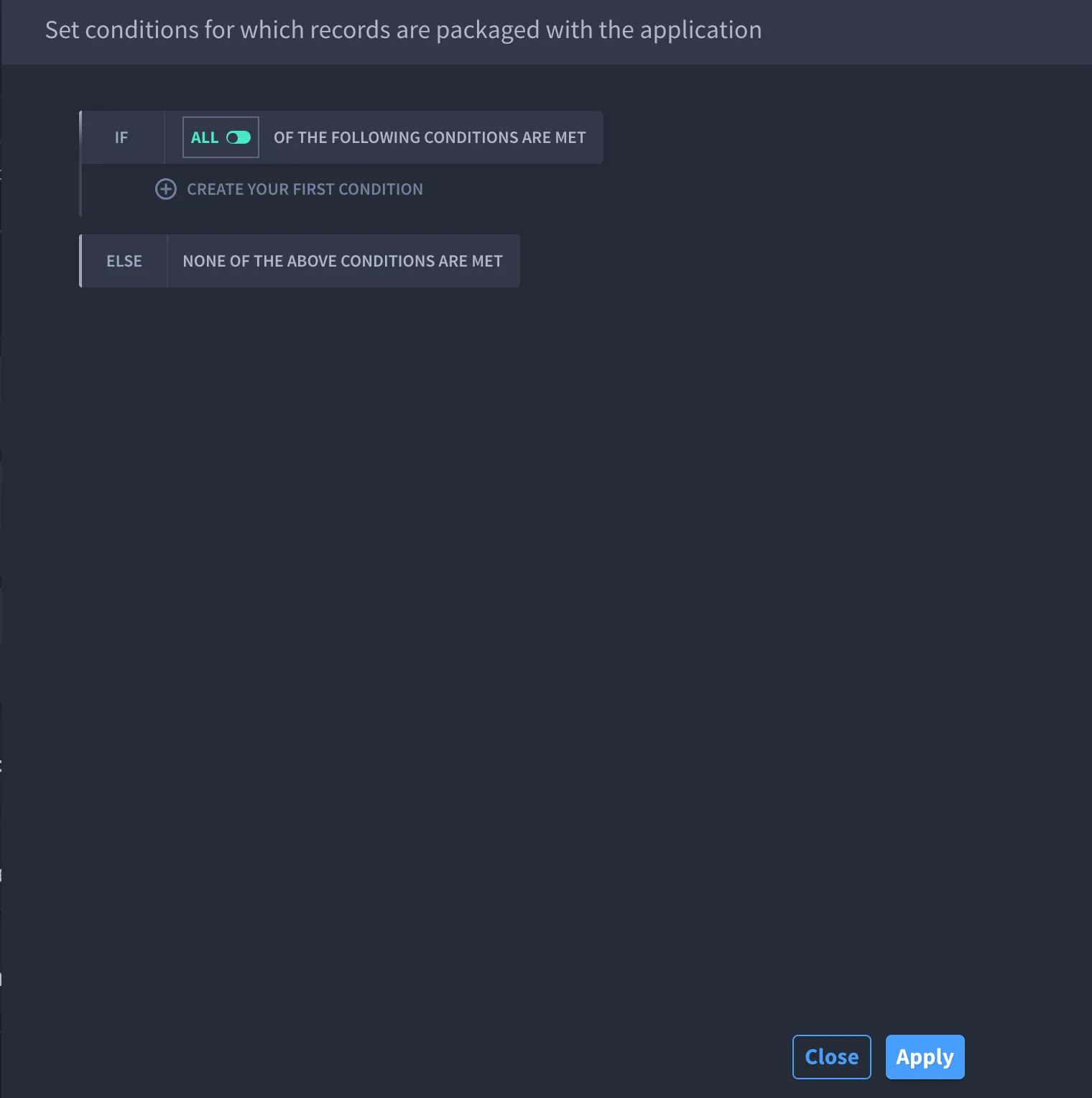
Create Conditions
- Click Create Your First Condition.
- Configure the Field, Operator, and Value. Example: Field = Title Operator = Equals Value = Phishing Investigation
- Use the toggle to enable ALL or ANY Condition.
- ALL: all conditions must match
- ANY: at least one condition must match
- Add additional conditions AND, OR, GROUP to create nested filtering logic.
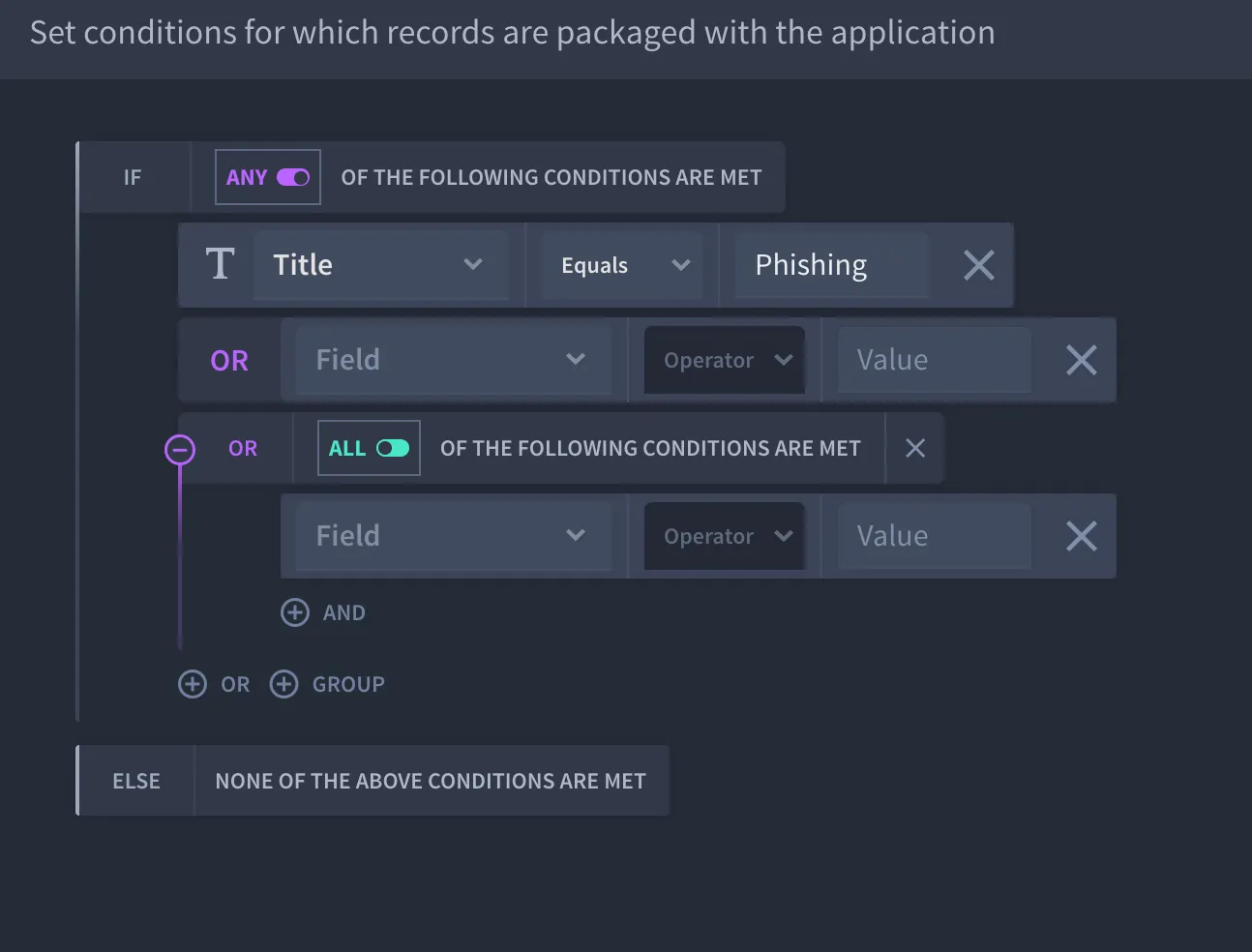
- The ELSE section defines records that are excluded from the export.
- Click Apply to save the filter.
Export a Playbook SSP
- Navigate to Orchestration, then Playbooks.
- Find the playbook you want to export.
- Click the ellipsis icon and select Export.
- Turbine displays a preview. Review and click Export to download.
You can also export from within an open playbook by clicking the ellipsis icon in the playbook taskbar and selecting Export.
If the playbook has parent or nested playbooks, they are included in the export automatically.
Export a Builder Component or Solution SSP
- Navigate to the builder component or builder solution you want to export.
- Click the ellipsis icon or context menu for the entity.
- Select Export.
- Turbine displays the entity tree. Dependent components and their playbook flows are auto-selected and locked.
- Review the selection and click Export to download the .ssp file.
When you export a builder solution, all associated builder components and their playbook flows are included and cannot be deselected. This ensures the solution remains functional after import.
Export a Global SSP
Use global export to package multiple applications, applets, builder components, builder solutions, and playbooks into a single SSP.
- Open the Applications and Applets page.
- Click the plus icon and select Import or Export a package.
- Select the Export radio button.
- Select the check boxes next to all entities you want to include across any combination of types.
- Click Export.
Selection | File Name |
|---|---|
Multiple entities or all entities | Swimlane Global Export Package.ssp |
A single entity | Uses that entity's name (for example, My Application.ssp) |
Select and Deselect Entities
During export, Turbine displays a tree view of all entities and their dependencies based on the relationship graph. The tree shows each entity with its type (application, playbook, component, and so on) and any child entities nested beneath it.
You can:
- Select or deselect individual entities by clicking their check box.
- Select All or Deselect All using the bulk toggle at the top of the list.
- View auto-selected dependent entities, which appear with a locked check box and cannot be deselected independently.
Dependency Auto-Selection Rules
When You Select | Turbine Also Selects |
|---|---|
A builder solution | All child builder components and their playbook flows (locked) |
A builder component | All nested builder components it depends on (locked) |
A playbook | All connectors referenced by the playbook |
A parent entity | All child entities beneath it |
For applet exports, entity selection is not available. The entire applet and its dependencies are always exported.
Review Export Results
After validation or after the export completes, Turbine displays a results screen with up to three tabs.
Tab | Contents |
|---|---|
Take Action | Actionable issues you can resolve inline. A yellow badge shows the count. |
Take Note | Non-actionable informational warnings that do not block the export. |
Export Inventory | A read-only tree of all entities included in the exported package. |
Actionable vs. Non-Actionable Issues
Category | Description | Example |
|---|---|---|
Actionable | Issues that require your attention before the export is fully functional on import. | A secure credential was removed; a key store reference was stripped. |
Non-actionable | Informational warnings. The export can proceed. | A referenced entity outside the package is missing; a dependent entity was not selected. |
Common Error Types
Error | Meaning | Resolution |
|---|---|---|
Credential removed | A secure credential was stripped during export. | Reconfigure the credential after import. |
Missing reference | A referenced entity is not included in the package. | Add the missing entity to the export selection, or accept the warning. |
Plugin version mismatch | The target system has a different plugin version. | Upgrade or downgrade the plugin on the target system. |
Incompatible Swimlane version | The SSP requires a newer Turbine version. | Upgrade the target Turbine instance. |
Dangling reference | An entity references a playbook, sensor, or asset that no longer exists. | Use Perform Cleanup and Retry to remove the broken reference and re-validate. |
Disabled playbook | A playbook was disabled as part of the export. | The playbook can be enabled after import. |
Disabled sensor | A sensor (webhook) was disabled as part of the export. | The sensor can be enabled after import. |
Use Cleanup and Retry
If the export detects dangling references (orphaned playbooks, sensors, orchestration tasks, or components), a Perform cleanup and retry button appears in the footer.
- Click Perform cleanup and retry.
- Turbine removes the broken references from the source system.
- Turbine re-validates the export automatically.
- Review the updated results.
Cleanup modifies the source system by removing orphaned references. This action cannot be undone.
Copy or Download Export Notes
From the results screen, you can save a summary of all issues and warnings.
- Click Copy Notes to copy the summary to your clipboard.
- Click Download Notes to save it as a .txt file.
Navigate to the Source Entity
If errors prevent the export, the footer displays a navigation button based on the entity type.
Entity Type | Button |
|---|---|
Application | Go to Application |
Applet | Go to Applet |
Playbook | Go to Playbook |
Click the button to open the entity in the builder, resolve the errors, and retry the export.
Publish to Content Library
If your Turbine instance is connected to a Content Library, you can publish an SSP directly instead of downloading it. The publish wizard guides you through a multi-step process.
Step 1: Content Information
Choose how to publish:
Option | Description |
|---|---|
Publish as new content (V1) | Creates a new entry in the Content Library. Enter a name and optional description. The version is set to 1.0.0. |
Publish as a new version of existing content (V1+) | Updates an existing Content Library entry. Select the existing package from a table showing name, current version, and last-modified date. Enter a new version number. |
Step 2: Package Content
Turbine displays the entity tree. Select or deselect entities the same way as a standard export.
Step 3: Review Changes
Turbine validates the package and displays any potential issues. Review actionable and non-actionable issues. You can resolve issues now or continue publishing.
Step 4: Summary
Review the final publish details:
- Name and version of the content.
- Commit message describing the changes.
Click Publish to push the SSP to the Content Library.
Resolve Merge Conflicts
If the Content Library detects a conflict between your local content and the remote repository, Turbine displays a merge conflict screen.
For each conflicting SSP, you see two options:
Option | Description |
|---|---|
Keep local changes | Overwrites the remote version with your local version. Shows who last published and when. |
Keep remote changes | Discards your local version and keeps the remote version. Shows who last published and when. |
- Select your resolution for each conflicting SSP.
- Click Apply to resolve the conflicts.
- If new conflicts arise after resolution, repeat the process.
Handle Sync Errors
If the publish succeeds locally but fails to sync to the remote repository, Turbine displays an error:
To resolve:
- Wait a few minutes and retry.
- If the error persists, manually push the changes from the local content library.
- Contact support if the issue continues.