Import Swimlane Solution Packages
Import Swimlane Solution Packages (SSPs, file extension .ssp) into a Turbine instance. Packages contain one or more applications, applets, playbooks, builder components, or builder solutions along with all associated entities.
At a Glance
Step | Action |
|---|---|
1 | Upload the .ssp or .json file. |
2 | Review and select the entities to import. |
3 | Optionally turn on Import playbooks/webhooks in enabled state. If you turn it on, choose whether to retry skipped playbook runs. |
4 | Resolve any duplicate or overwrite conflicts. |
5 | Resolve any plugin version requirements. |
6 | Monitor import progress. |
7 | Review results and resolve actionable issues. |
8 | Enable any remaining disabled playbooks and webhooks. |
9 | Reconfigure credentials, key store values, and secure asset fields. |
Importing SSPs requires the System Administrator role.
Connectors are not included in SSPs. Install and configure required connectors separately before importing. During import, Turbine displays connector cards showing which connectors are needed so you can verify they are installed.
Upload and Import an SSP
- Open the Applications and Applets page.
- Click the plus icon and select Import or Export a package.
- Drag and drop your .ssp or .json file into the dialog, or click Browse to select it.
- Wait for Turbine to upload and validate the package. A spinner indicates upload progress.
After validation, Turbine either proceeds to the entity selection screen (if the SSP contains a relationship graph) or directly to import (for older SSP formats).
Select Entities to Import
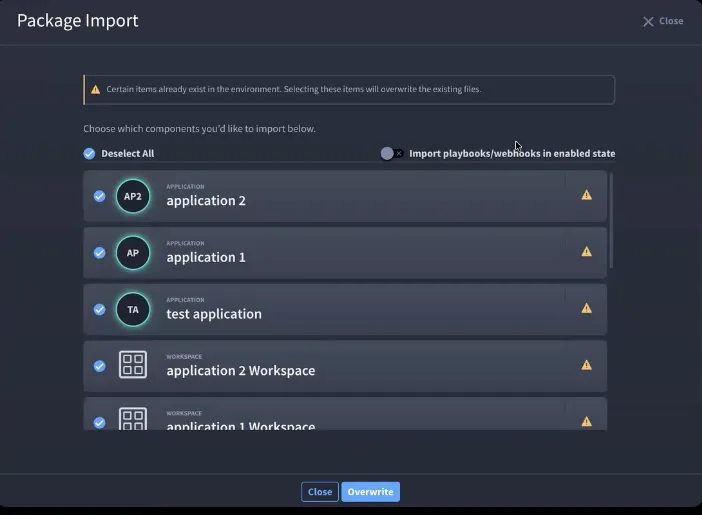
After validation, Turbine displays a tree view of all entities in the package. The tree shows each entity with its type label and any child entities nested beneath it.
- Review the entity tree. By default, all entities are selected.
- Use the Select All / Deselect All toggle to change the selection in bulk.
- Click individual check boxes to include or exclude specific entities.
- Optionally, turn on Import playbooks/webhooks in enabled state (see below).
- Click Import (or Overwrite when selected items already exist in the tenant).
Import Playbooks and Webhooks in Enabled State
By default, imported playbooks and webhooks stay disabled. That is safer while a package is still loading, but any matching trigger during the import window (webhook POST, scheduled tick, or another inbound event) is skipped. After import, you would otherwise enable the content from Take Action, and those skipped runs would not run again unless you retry them later from Operational Health.
Starting in Turbine 26.4.0, the entity-selection screen includes Import playbooks/webhooks in enabled state. The same toggle appears when you deploy from the Content Library.
Choice | What happens |
|---|---|
Toggle off (default) | Playbooks and webhooks remain disabled after import. Enable them later. Skipped runs from the import window are not replayed as part of this import. |
Toggle on, then No | After entities finish importing, Turbine enables the imported playbooks and webhooks. It does not replay skipped runs from the import window. |
Toggle on, then Yes | Turbine enables the imported playbooks and webhooks, then replays skipped playbook runs from the import window. |
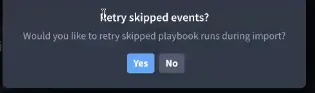
When you turn the toggle on, Turbine asks:
Retry skipped events?
Would you like to retry skipped playbook runs during import?
- Yes — enable, then replay skipped runs from the import window.
- No — enable only.
You cannot replay skipped runs unless the enable toggle is on. Replay always runs after enablement.
Use this when you need the solution running as soon as import finishes, and you do not want webhook or schedule traffic from the import window to be lost.
Package try / dry-run does not enable playbooks or webhooks and does not replay skipped runs.
What Turbine Replays
The replay window starts when you start the import and ends after the imported entities are loaded and enabled.
Trigger type | What happens |
|---|---|
Webhook and other inbound events | Turbine replays each skipped run that targeted an imported playbook during the window, in the order the events arrived. |
Scheduled (cron) playbooks | If a schedule fired more than once while the playbook was still disabled (for example, a one-minute schedule during a multi-minute import), Turbine replays only the most recent missed tick for that playbook. Earlier ticks in the same window are not replayed. |
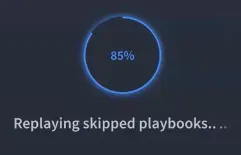
Progress can show these phases after the package contents are imported:
- Enabling imported playbooks and webhooks
- Replaying skipped playbooks...
On a small package, these phases can be brief.
Import Results: Enablement and Replay Summary
When enablement (and optional replay) ran, the import results include a reactivation summary. Depending on what occurred, it can include:
- How many playbooks and builder playbooks were enabled
- How many playbook runs were skipped during the import window
- How many of those runs were submitted and queued for replay
- Whether older scheduled ticks were skipped because a newer missed tick for the same playbook was replayed
- Playbook IDs that were enabled
You can still review skipped and replayed runs in Operational Health → Events. Filter around the import finish time to confirm webhook and schedule activity.
If you enabled content but skipped replay, retry individual or bulk skipped runs from Operational Health after import. See the Operational Health Events topic for retrying runs skipped while a playbook was disabled.
Partial Import Warning
If you deselect some entities from the package, Turbine displays a confirmation dialog:
You can click Cancel to return to the selection screen, or Install Anyway to proceed with the partial import.
SSPs exported from Turbine versions before 11.4.0 do not support selective entity import. All entities in those packages are imported automatically.
Import Application Records
You can import application records packaged within an SSP into another tenant.
Before importing:
- Ensure you are logged into the destination tenant.
Take the following Steps to Import Application Records:
- Navigate to Applications & Applets.
- Click the plus icon.
- Select Import or Export a package.
- Select Import. Drag and drop the .ssp file or browse for it and open it.
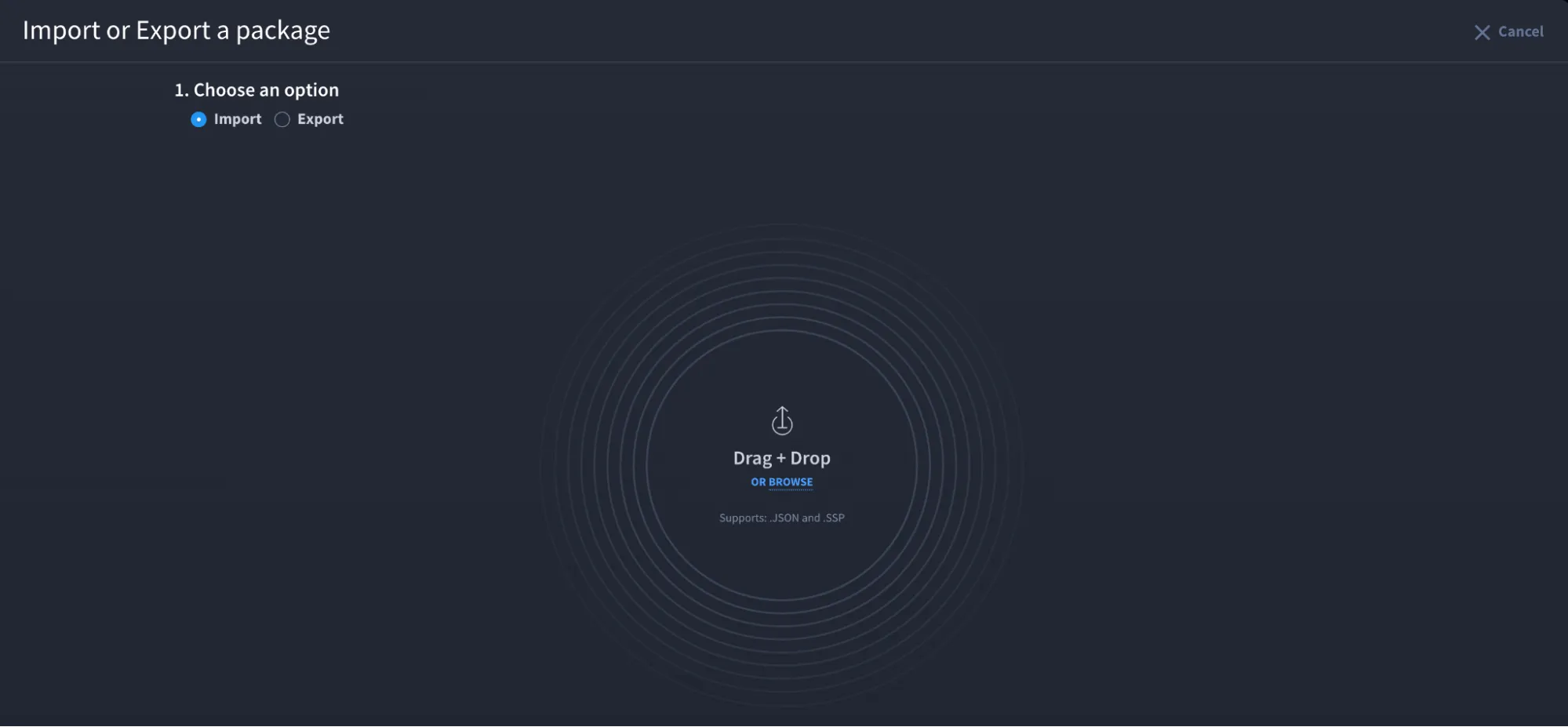
- Turbine uploads and validates the package. The Package Import dialog opens.
- Applications that contain exported records display an Import Records toggle.
- Enable the toggle for:
- KB Article
- Routing Rule
- Click Import Settings to configure record import settings. Refer to the Configure Import Settings for more information.
Configure Import Settings
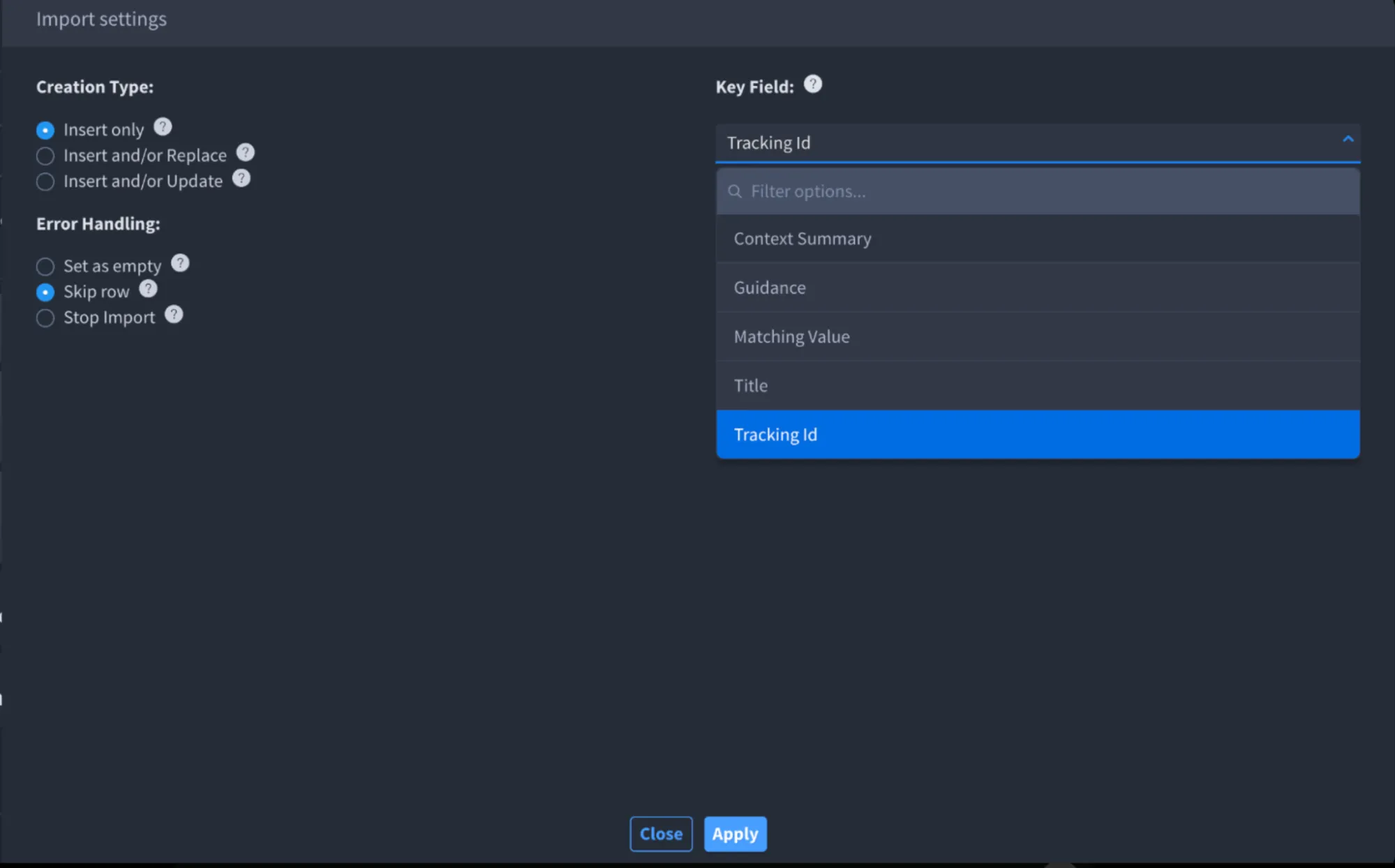
Key Field
The Key Field determines how imported records are identified. Available options in the dropdown include all columns from the exported .csv file. By default Tracking ID is selected.
Creation Type
The following creation modes are available:
Option | Description |
|---|---|
Insert only | Inserts new records only |
Insert and/or Replace | Replaces matching records |
Insert and/or Update | Updates existing matching records |
By default Insert only is selected.
Error Handling
The following error handling options are available:
Option | Description |
|---|---|
Set as empty | Sets invalid values to empty |
Skip row | Skips records with errors |
Stop Import | Stops the import process |
By default Skip row is selected.
Complete the Import
- Click Apply to save import settings.
- Click Import.
Turbine imports the records into the selected applications.
Reference Fields
When importing records that contain reference fields:
- References are preserved when the referenced application and records exist in the destination tenant.
- References are also preserved when the referenced records are imported as part of the same SSP.
- If a referenced application is not imported and does not exist in the destination tenant, the reference value cannot be resolved.
- If referenced records are not imported or cannot be matched in the destination tenant, the reference value is imported as empty.
Turbine may display warnings when reference values cannot be resolved during import.
- If you do not open Import Settings, the import uses the default settings:
- Key Field = Tracking ID
- Creation Type = Insert only
- Error Handling = Skip Row
- Before carrying out Import, it is recommended to read Export Application Records.
Handle Connectors During Import
SSPs reference connectors by name but do not include connector packages. When you select entities that reference connectors, Turbine displays a connector panel next to the entity tree.
The panel shows:
- The number of connectors required (for example, "In order for this SSP to import successfully, we must import 2 Connectors first.").
- A card for each connector showing its icon, title, and author from the Marketplace.
- A View Details link on each card to open the connector's full Marketplace details.
If a referenced connector is not installed on the target system:
- Note the connector name from the panel.
- Install it from the Marketplace before or after import.
- If you import without the connector, Turbine displays a warning. You can install the connector later and manually link it.
Resolve Duplicate and Overwrite Conflicts
If an entity in the package already exists in the target environment, Turbine alerts you.
Non-Selectable SSPs (No Relationship Graph)
If the SSP does not contain a relationship graph, Turbine displays a list of duplicate entities with a warning icon. You must confirm the overwrite for all duplicates:
- Review the list of existing entities that will be overwritten.
- In the confirmation dialog, press and hold the mouse button on the overwrite button to confirm.
- Release to complete the overwrite.
Selectable SSPs (With Relationship Graph)
If the SSP contains a relationship graph, Turbine shows duplicate entities highlighted in the entity tree with an overwrite icon.
Conflict Type | Description | Action |
|---|---|---|
UID conflict | An entity with the same unique identifier already exists. | Select the entity to overwrite it, or deselect to skip. |
Name or acronym conflict | A different entity with the same name or acronym exists. | Select to overwrite, or deselect to skip. |
A warning message appears at the top of the selection screen:
If any selected entity requires an overwrite, the Import button changes to Overwrite. Click it, then press and hold to confirm.
Import Errors: Same Name, Different Sharing ID
Sometimes the entity tree does not list an item as a simple duplicate, but the import still stops with errors when Turbine saves packaged entities. Typical messages include:
- Builder component: BuilderComponent named '<name>' already exists in this environment with a different sharing Id. To proceed further with the import, the existing BuilderComponent must be renamed.
- Playbook: Playbook with name '<name>' already exists
- Asset or other entities: An error was encountered while saving the asset or Save of <entity> failed (often with a chain of dependent builder components listed in the error text)
What this means: The target tenant already has an entity with the same name as something in the package, but that existing entity came from another export or solution and has a different sharing identity than the one in the SSP. Turbine does not merge those automatically. The text is intentional so you know exactly which name conflicts and that you must act before the import can succeed.
Approach | When to use it |
|---|---|
Rename or delete the conflicting entity in the target tenant | You want to keep the version from the SSP and the UI directs you to free the name (for example rename the existing builder component or playbook). |
Change what you import | On the entity selection screen, deselect types or items you do not need, if overlapping content from two solutions makes part of the package redundant. |
Adjust the package | Work with your team to rename entities inside the SSP (or re-export from a clean source) when bulk collisions are hard to fix in the tenant. |
Use a clean tenant | You need a full import without resolving many collisions (for example a new environment used only for that solution). |
For long error lists, use Copy Notes or Download Notes on the import results screen, or capture a HAR file while reproducing the import, so support can see the same messages you see.
Resolve Plugin Version Requirements
If the SSP requires plugins that are a different version than what is installed on the target system, Turbine pauses the import and displays a notification.
- Review the list of plugins that need to be upgraded.
- Upgrade each plugin to the required version.
- After all plugins are upgraded, click Continue to resume the import.
If the target system has a newer plugin version than the SSP expects and the SSP requires a downgrade, the import cannot proceed. Re-export the SSP from a system with a compatible plugin version.
Monitor Import Progress
After you start the import, Turbine displays a progress spinner with a percentage and a real-time status label.
Progress | Status Label |
|---|---|
0% | Preparing to start the import |
10% | Validating package contents |
20% | Installing required connectors |
30% | Processing entities to import |
40% | Validating entities |
50% | Importing entities |
70% | Linking and verifying relationships between entities |
80% | Running integrity checks |
90% | Finalizing import |
100% | Import complete |
The progress indicator shows the current percentage in the center of the spinner. If the import fails, the spinner displays Import Failed with an error message below it.
You cannot cancel an import once it has started. Wait for the import to complete or fail before taking further action.
Review Import Results
After the import completes, Turbine displays a results screen with up to three tabs.
Tab | Contents |
|---|---|
Take Action | Actionable issues you can resolve inline. A yellow badge shows the count of remaining issues. |
Take Note | Non-actionable informational warnings. These do not prevent the solution from functioning. |
Import Inventory | A read-only tree of all entities that were imported. |
Actionable vs. Non-Actionable Issues
Category | Description | Examples |
|---|---|---|
Actionable (Take Action tab) | Issues that require your action for the solution to be fully functional. Resolving them inline marks them as complete. | A secure credential was removed; a key store reference was stripped; an asset configuration needs updating. |
Non-actionable (Take Note tab) | Informational warnings you should be aware of but that do not require immediate action. | A playbook was disabled during export; a webhook URL was modified. |
Each actionable issue shows the affected entity name, the issue description, and a control to resolve it (for example, reconfigure a credential or enable a disabled task). After you resolve an issue, it is marked as complete and the count decreases.
Post-Import Actions
From the results screen footer, you can:
Button | Action |
|---|---|
Go to Application | Opens the imported application in the builder so you can review and fix issues. |
Go to Applet | Opens the imported applet in the builder. |
Import More | Returns to the upload screen to import another SSP. |
Close | Closes the import dialog. |
Copy or Download Import Notes
From the results screen header, you can save a summary of all issues and warnings.
- Click Copy Notes to copy the summary to your clipboard.
- Click Download Notes to save it as a .txt file named Swimlane Import Package.txt.
Enable Playbooks and Webhooks After Import
Unless you used Import playbooks/webhooks in enabled state, playbooks and webhooks remain disabled after import. Enable them from the results banners or from Playbooks / webhook configuration before the solution is fully operational. Starting in Turbine 26.4.0, you can also replay skipped runs during import instead of only from Operational Health.
Enable Playbooks
After a successful import, if there are disabled playbooks, Turbine displays an info banner:
- Click Enable N Playbooks (where N is the count) to enable all disabled playbooks at once.
- Alternatively, navigate to the Playbooks page and enable them individually.
The Include Scheduled Tasks toggle controls whether scheduled-trigger playbooks are included in the bulk enable. Toggle it off to exclude scheduled playbooks from the bulk action.
Enable Webhooks
If there are disabled webhooks, a similar banner appears:
- Click Enable N Webhooks to enable all at once.
- Alternatively, enable them individually from the webhook configuration.
Enable Builder Playbooks
If the SSP contains builder solutions with disabled builder playbooks, you can enable them in bulk from the import results screen. Turbine clears the "disabled" status and removes the associated informational messages.
Reconfigure Credentials and Secure Values
During export, the following are removed for security:
Item | Post-Import Action |
|---|---|
Secure credentials in assets | Open each asset and re-enter the credentials. |
Key store values mapped to task inputs | Open the application and add the key store references. |
Secure values in asset configurations | Open each asset and reconfigure the secure fields. |
Dynamic Orchestration asset credentials | Open each DO asset and re-enter credentials. |
Sensor credentials | Open each sensor and re-enter credentials. |
Webhook URLs | Verify and update webhook URLs if they have changed. |
These items appear on the Take Action tab of the import results. Resolve each one to mark it as complete.
Deploy from Content Library
When importing from the Content Library (deploy flow), the experience is the same as a standard import with the following differences:
Difference | Standard Import | Content Library Deploy |
|---|---|---|
Terminology | "Import," "Importing" | "Deploy," "Deploying" |
Dialog title | "Import" or "Package Import" | "Deploy Package" or entity-specific (for example, "Deploying Playbook") |
Inventory tab label | "Import Inventory" | "Deployed Inventory" |
Import More button | "Import More" | "Deploy More" (if applicable) |
All other functionality (entity selection, overwrite handling, progress tracking, and result review) is identical. The Import playbooks/webhooks in enabled state toggle and Retry skipped events? confirmation also apply to Content Library deploy. Package try / dry-run does not enable content or replay skipped runs.
Version History and Revert
When working with Content Library content, the import dialog includes additional tabs for managing versions.
View Version History
- Open the content from the Content Library.
- Select the Version History tab.
- Review the table showing each version with its version number, last modified timestamp, and commit message.
Revert to a Previous Version
If a newer version introduces issues, you can revert to a previous version.
- In the Version History tab, click Revert.
- Select the version you want to revert to by clicking its radio button.
- Enter a new version number for the reverted content. The version must be valid and unique.
- Enter a reason for reverting in the commit message field.
- Click Revert to confirm.
On success, Turbine displays a confirmation:
After reverting in the Content Library, the version in tenant environments may be out of sync. Redeploy the reverted content to each tenant to apply the change.
If the revert fails, Turbine displays an error message. Wait a few minutes and try again. If the error persists, contact support.
Troubleshooting
Issue | Cause | Resolution |
|---|---|---|
Import fails with "Incompatible Swimlane version" | The SSP was exported from a newer Turbine version. | Upgrade the target Turbine instance. |
Import fails with "Plugin upgrade required" | The target system has an older version of a required plugin. | Upgrade the plugin from the notification, then click Continue. |
Import fails with "Plugin downgrade required" | The target system has a newer plugin version than the SSP expects. | Re-export the SSP from a system with the matching plugin version. |
Import fails with "Dynamic Orchestration feature flag required" | The SSP uses Dynamic Orchestration but the flag is not enabled. | Enable the Dynamic Orchestration feature flag, then retry. |
Import fails with "Python version" error | The SSP requires a different Python version. | Verify the Python runtime version on the target system. |
"Could not load file in package" | A file is missing or corrupted in the SSP. | Re-export the SSP from the source system, or see Repackage an Unzipped SSP FileRepackage an Unzipped SSP File. |
Playbooks not running after import | Playbooks are disabled during export by default. | Enable playbooks from the import results screen, or use the Import playbooks/webhooks in enabled state toggle during entity selection (optionally replay skipped runs). |
"No connector matching the provided name exists" | A referenced connector is not installed on the target system. | Install the connector from the Marketplace before retrying. |
"Solution not working as intended" after partial import | Some dependent entities were not imported. | Re-import the SSP with all entities selected. |
Import stalls at a percentage | A network or server issue interrupted the process. | Wait for the import to time out, then retry. If the issue persists, check server logs. |