Webhooks
Term | Definition | Characteristics |
|---|---|---|
Triggers | A trigger initiates playbook processes. While a playbook can only have one trigger per flow, it can have more than one trigger and/or trigger type. Turbine currently uses several types of triggers to retrieve and/or ingest data. | Current triggers:
|
Webhooks are a type of event stream that enables products, vendors, or services to push real-time communication into Turbine. They process and enrich data from third-party services and platforms, sending it to Turbine records.
When to Use Webhooks
- You want external systems to push events to Turbine in real time.
- You want to avoid polling APIs for new data.
- You need a simple ingestion method for alerts or events.
- You want a confirmation landing page when a human opens the webhook URL in a browser (for example an email link).
- You want Slack, Teams, or another automated caller to receive JSON (or the legacy empty body) instead of HTML.
Security Considerations
- Treat webhook URLs as secrets and rotate them if exposed.
- Use authentication when possible.
- Validate incoming payloads before acting on them.
Key Benefits
- Real-Time Data Integration: Webhooks enable seamless real-time communication between external platforms and Turbine, ensuring that data flows into the system as events happen, reducing the need for polling or manual updates.
- Automation: With webhook triggers, Turbine playbooks can respond instantly to events like system alerts or user actions, streamlining incident response and enhancing workflow automation.
- Customizable Event Handling: Webhooks can be customized to handle specific events, enabling flexible automation workflows tailored to business needs.
- Efficient Data Processing: As webhook events trigger specific playbook actions, Turbine can ingest, process, and transform data efficiently, reducing manual workloads and minimizing human error.
- Scalability: Webhooks allow organizations to handle high volumes of event-based triggers without requiring constant API calls, improving scalability.
Webhook Response (26.4.0)
Starting in Turbine 26.4.0, Canvas webhook triggers can define what the caller receives when the webhook URL is invoked.
On Edit Webhook → Advanced → Webhook Response, set Response Format:
Format | Typical Use |
|---|---|
Default | Legacy empty response (existing webhooks stay unchanged until you change the format). |
HTML | Browser landing page only. Slack and Teams do not display this page. |
JSON | Structured acknowledgment for API clients, Slack, or Teams. |
You can insert $event.data.* from the incoming request (Add Expression), preview the response before saving, and keep the body within the 10000-character limit. Webhook response cannot use playbook properties or assets. If Preview shows undefined on a reference, add that field to Context Data. Empty Context Data does not blank static text.
Authentication is optional for HTML, JSON, and Default. You can save an HTML landing page without configuring authentication on Settings.
This setting controls the outgoing response. It does not replace Configure → Outputs payload format options, which control how Turbine parses the incoming request body.
For steps, security guidance, and preview details, see the Configure Webhook Response section in Using Webhook Triggers in Swimlane TurbineUsing Webhook Triggers in Swimlane Turbine.
Custom webhook responses apply to Solution Builder / Canvas webhooks only. On Orchestration → Webhooks, a Canvas-linked webhook opens the new Edit Webhook dialog (Advanced). A classic webhook opens the previous dialog, without Advanced.
Homepage
To access webhooks, follow these steps:
- Log in to Turbine.
- From the left-hand navigation pane, click ORCHESTRATION and then click Webhooks.
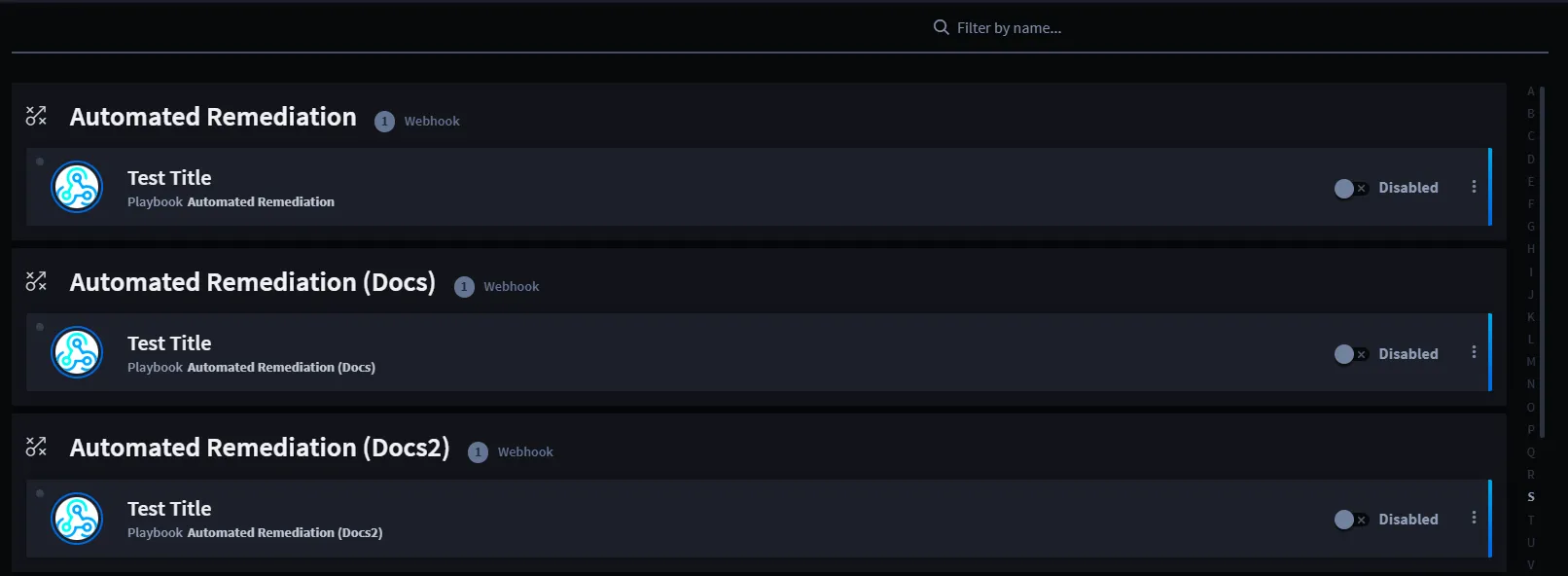
From the Webhooks homepage, a list of available (disabled or enabled) webhooks is shown, automatically sorted alphabetically and by playbook. If a playbook has more than one webhook, all of the webhooks will display under the playbook's name. You can use the features listed in the table to navigate the webhooks homepage for a faster and easier experience.
Feature | Function |
|---|---|
Filter by name | Use to filter by webhook name |
Disabled/Enabled | Toggle between the disabled (default) or enabled status |
Ellipsis icon | Click to edit the webhook in the canvas |
See Using Webhook Triggers in Swimlane TurbineUsing Webhook Triggers in Swimlane Turbine for creating and configuring Canvas webhook triggers, including webhook response (landing page and JSON).
For classic playbooks, see Webhook Triggers (Classic).