Dashboards
A dashboard is a workspace view of cards (reports, charts, HTML, or usage stats) for the applications in that workspace. Use dashboard-level All Filters and date range to scope many cards at once without editing each report.
You need permission to access Workspaces, Dashboards, Records, and Reports. If a dashboard or report is missing, ask your administrator to confirm access.
Choose Your Path
Goal | Where to go |
|---|---|
Open a dashboard | |
Filter cards at runtime | Dashboard Operations (All Filters, date range) · Dashboard Filtering OptionsDashboard Filtering Options |
Add, resize, or arrange cards | Dashboard Card OperationsDashboard Card Operations |
Share, email, or download PDF | Share and Download DashboardsShare and Download Dashboards |
Click a chart to filter records in Search | Drill-inDrill-in |
Card shows wrong data, empty state, or export gap |
Dashboard Behavior and Limitations
These behaviors are intentional. They can look like defects if you expect the same rules as Search or Reports.
Topic | Behavior |
|---|---|
All Filters scope | Each All Filters entry applies only to report cards whose report belongs to that same application. |
Standard chart cards | All Filters and the dashboard date range merge on top of each report’s saved filters when the card loads. |
Widget (PyGrid) cards | PyGrid widgets use custom code; All Filters and report filters do not match built-in charts. Widgets are not included in PDF, email, or scheduled exports. |
Charts: empty data and limits | Built-in charts may show No data to display, an error message, or too many items. Wording can differ from Search because the card runs the saved report. |
Table-only report cards | Reports with no chart show a data table in the card. Chart-only empty states do not apply. |
Refresh and saved changes | Refresh re-runs the query. To pick up saved report edits from another session, reload the dashboard in the browser. |
Exports | PDF, email, and schedules use each report’s saved filters and chart settings. Unsaved Search edits are not included until the report is saved. See Share and Download DashboardsShare and Download Dashboards. |
Chart drill-in | Chart click opens Search with dashboard filters (All Filters, date range) and drill-in from your click. See Drill-inDrill-in for steps and grouping limits. |
Dynamic card height | Changing the date range or loading more data can resize chart cards and reflow neighbors. Some cards may briefly show No data to display until you refresh, resize a card, or reload the page. |
Accessing Dashboards
- From the global navigation menu, go to Workspaces.
- Select a workspace.
- Select a dashboard by name.
Dashboards are scoped at the tenant level and can belong to multiple workspaces.
Dashboard Operations
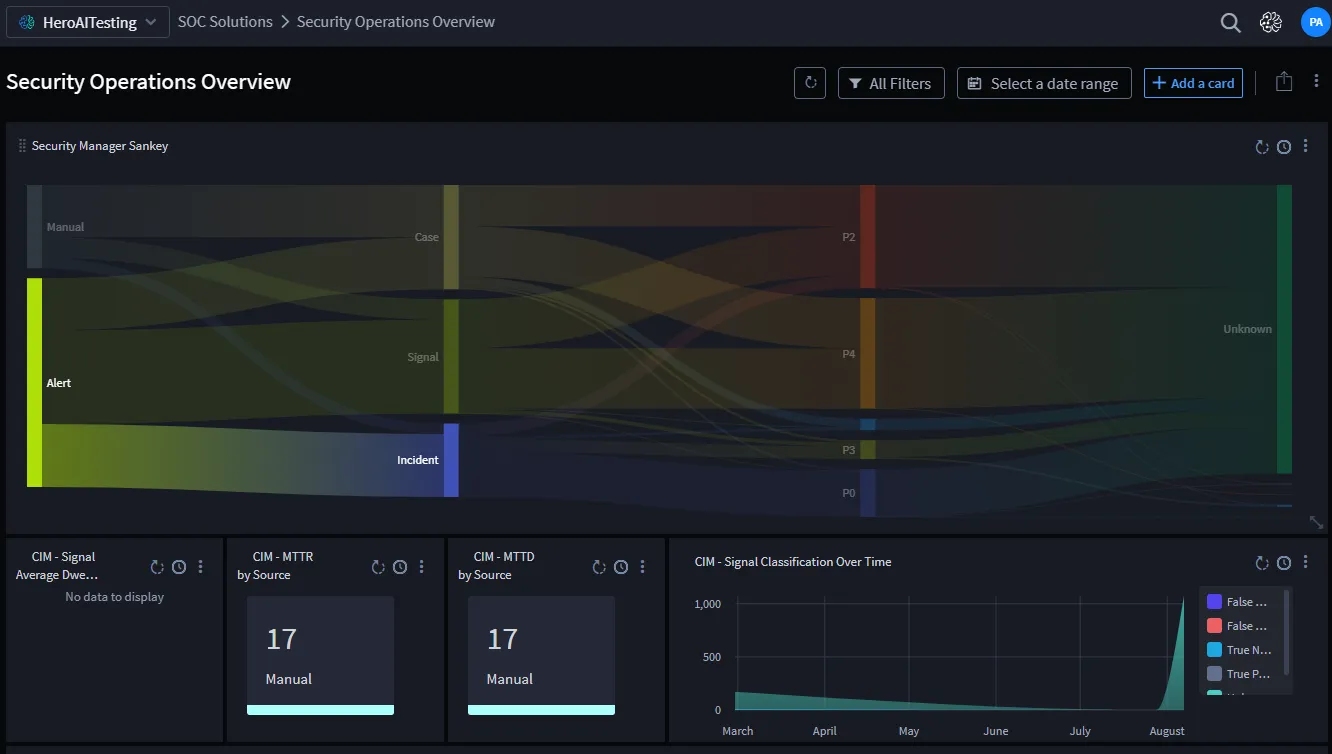
The dashboard toolbar includes:
- Mark as Favorite — Select the star next to the dashboard name.
- Refresh Data — Reload card data.
- Add a Card — Select + Add a card (same flow as from the Home page).
- All Filters — Apply runtime filters by application. See Dashboard Filtering OptionsDashboard Filtering Options.
- Date Range — Select a preset (for example, Last 7 Days) or a custom window. If no date field is configured for an application, the control is disabled. Configure fields under Settings and Schedules → Time Filters. Default when enabled: Today so far.
- Sharing — Download, schedule, or email snapshots. See Share and Download DashboardsShare and Download Dashboards.
- Manage Settings (⋮) — Creating a New User DashboardCreating a New User Dashboard, Settings and Schedules (name, description, permissions), delete dashboard, or edit the workspace.
Dashboard filters apply on top of each report’s saved filters. Widget (PyGrid) cards follow different rules. If you have dashboard access but not report access, the card shows a permission message instead of No data to display. See Dashboard Behavior and Limitations.
Dashboard Management
Administrators and Orchestrators manage user Home Pages from Management > Dashboard. See Management.
See Also
- Dashboard Card OperationsDashboard Card Operations
- Dashboard Filtering OptionsDashboard Filtering Options
- Share and Download DashboardsShare and Download Dashboards
- Drill-inDrill-in
- WorkspacesWorkspaces